What You Know About Indians Native American Issues Are Not History
I is for Ignoble: Stereotyping Native Americans
Past Arlene Hirschfelder and Paulette F. Molin
Published February 22, 2018
A common belief in the gimmicky United States, often unspoken and unconscious, implies that everyone has a right to use Indians as they run into fit; everyone owns them. Indianness is a national heritage; information technology is a fount for commercial enterprise; it is a costume i tin put on for a party, a youth activeness, or a sporting event. This sense of entitlement, this expression of white privilege, has a long history, manifesting itself in national narratives, pop entertainments, marketing schemes, sporting worlds, and self-comeback regimes. [1]
From the earliest catamenia of European colonization, images of Indians institute expression in early drawings, engravings, portraiture, political prints, maps and cartouches, tobacconist figures, atmospheric condition vanes, coins and medals, and books and prints. Initially, depictions of Native males and females were used to symbolize the North American continent in the international iconography of the day, representations that proliferated. The Indian Queen, an allegorical figure in use by the cease of the sixteenth century, symbolized the Western Hemisphere. Her successor, the Indian Princess, became representative of the American colonies. During the Revolutionary period, America was portrayed equally a feathered Indian defying British tyranny in printed materials of the 24-hour interval.
As the United States grew, it developed a mythology that helped provide Americans with a commendable national heritage while serving to rationalize the dispossession and conquest of indigenous peoples. As National Museum of the American Indian curator Cécile R. Ganteaume points out, "American Indian imagery has been used by the federal government to distinguish the U.s. from other nations and to define the nation for its citizens, by U.S. armed forces to limited military might, by American corporations to signify integrity and by designers . . . to add luster and cachet to commercial products." [ii]
Institutionalized throughout the nation and exported to other countries, these images and others include dual portrayals of the adept Indian (those who assistance Europeans) and the bad Indian (those who resist Europeans), nostalgic vanishing, dauntless warriors, romantic princesses, and countless ignoble images of brutality and degradation. Such representations obliterate or mask the realities of tribal nations struggling to maintain their populations, lands, resources, and sovereignty.
Questions nigh indigenous people often begin with terminology. "At the museums and on social media," Kevin Gover, director of the National Museum of the American Indian, comments, "people ask at least once per 24-hour interval when we are going to take 'American Indian' out of our name." [3] Every bit he responds, "Native Americans employ a range of words to describe themselves, and all are appropriate. Some people refer to themselves equally Native or Indian; almost prefer to be known by their tribal amalgamation . . . if the context doesn't demand a more encompassing clarification." [iv] With respect to Canada, Gover notes that "terms such as First Nations and First Peoples are preferred." [5]
American Indians are richly diverse, yet all too oftentimes their public portrayals—in books, advertisements, shop signs, terminology, and even children's toys and games—are greatly at odds with actual Native peoples and cultures. As the National Congress of American Indians points out, "At that place are 567 federally recognized Indian Nations (variously called tribes, nations, bands, pueblos, communities and native villages) in the Usa. Approximately 229 of these ethnically, culturally and linguistically diverse nations are located in Alaska; the other federally recognized tribes are located in 35 other states." [vi] In addition, there are state recognized tribes across the land besides as other differences.
This essay explores selected themes centered on centuries-old stereotypes of American Indians: "Tomahawks and Knives": Stereotypical Violence; "Words Are Weapons": Language Representations; "Stereotypes Sell": Commercialization of Indians; "Self-Shaping": Playing Indian; "Braves" and "Chiefs": Indian Mascots; and "I is for Indian": Earth of Children. It is illustrated with images from the Jim Crow Museum, fatigued from its collection of objects depicting Native Americans and consistent with its goal to tell stories of injustice towards all groups.
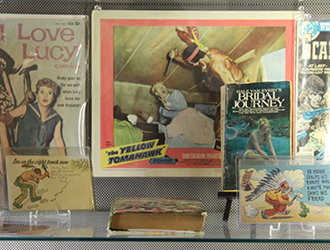 "Tomahawks and Knives": Stereotypical Violence
Almost whatever portrait that we come across of an Indian, he is represented with tomahawk and scalping knife in hand, as if they possessed no other only a barbarous nature. Christian nations might with equal justice be ever represented with cannon and ball, swords and pistols. [vii]
Throughout U. South. history, Euro-Americans committed endless acts of violence confronting Native people. Such acts include extermination or genocide, theft of Indian lands and resources, captivity and enslavement, forced removals from homelands, and schooling aimed at destroying Native cultures.
Violence continues today. A report by the U.South. Department of Justice shows that "American Indian and Alaska Native women and men endure violence at alarmingly high rates." [eight]
In an American Psychiatric Association blog post, research scientist Melanie Peterson-Hickey observes that high suicide rates among Native Americans are well documented, noting that the "trauma resulting from a history of race-based policy, discrimination and oppression has pregnant and longstanding touch." [9]
Nonetheless, equally Tuscarora Chief Elias Johnson has pointed out, American Indians are represented every bit barbarous, with tomahawk and scalping knife in mitt. In contrast, Euro-Americans are depicted as innocent victims of savagery, particularly from Indian males.
It is believed that European representations of Native people as violent appointment back to as early as 1591, when engraver Theodor DeBry engraved and published artist Jacques LeMoyne's 1564-65 drawing of Indian scalping. Furthermore, from the 17thursday to the xixth centuries, non-Indian observers portrayed Indians intent on "savage war" more violent than "civilized" combat of European and American governments. Increasingly pulp details of Indian savagery also appeared in captivity narratives, published from the 1600s to the 1800s, accounts of non-Indians captured and held prisoner past Indians. Dime novels, inexpensive booklets beginning marketed in 1859, became popular also. This bestselling fiction portrayed Indians every bit savages preying on caught Euro-Americans.
Wild Westward shows, performed beyond North America and Europe from the late 1800s into the xxth century, dramatized Indian attacks on stagecoaches and cabins as well as mock battles betwixt cavalry and Indians. William "Buffalo Bill" Cody and other showmen, including Plains Indians, drew huge audiences. These shows, and related influences, inspired filmmakers to produce Westerns depicting hordes of Indians attacking Euro-Americans. As a thing of fact, many American Indians were taken captive by non-Indians, tortured, incarcerated, murdered, and expelled into slavery. Considering Europeans and Euro-Americans colonists threatened Native peoples, many resisted mightily to defend their families and homelands.
The ongoing perception of Indians as dangerous contributes to negative expectations, interactions, and consequences. Thus, Indians are incarcerated at loftier rates, meet discrimination and detest crimes, and experience other negative impacts. Stereotyped Indian violence also leads non-Indians to fearfulness Native people.
Nonetheless, the "barbarous nature" representation of Indians, voiced by Elias Johnson, continues to pervade American culture via school curricula, books and toys, sports teams, media advertisements, and other ways. Such representations preclude others from seeing Native people realistically, including in a range of roles, settings, and occupations.
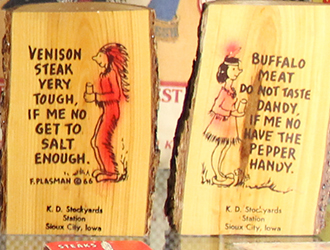 "Words Are Weapons": Language Representations
In contrast to the inane stereotype of the Indian as soundless, we know from the vast storehouse of our oral traditions that Aboriginal peoples were peoples of words. Many words. Astonishing words. Cultivated words. They were neither wordless nor illiterate in the context of their linguistic and cultural roots. [10]
Although more than than 300 Native languages existed in what is now the continental United States, "as different from each other every bit Turkish, English, and Chinese," that number greatly macerated in the aftermath of European colonization. [11] Indigenous population loss through disease and war exacted a toll every bit did ongoing measures to Europeanize and Christianize Native people at the expense of their own cultures and languages. Such measures included the establishment of mission and government boarding schools to implement English-merely and other harsh policies. As federal commissioners wrote, "their savage dialect should be blotted out and the English language substituted." [12]
With English, a dictionary of words and phrases became entrenched, a shorthand mode to refer to all Native people, language reflecting stereotypical attitudes and behaviors. Savage, pagan, injun, brave, buck, chief, redskin, squaw, papoose, and other terms became commonplace. The negative bear upon was heightened with the improver of adjectives such every bit wild, dirty, pesky, sneaky, and worse. "In an calumniating society," activist Suzan Shown Harjo points out, "language is a command mechanism . . . and words are weapons used to signal status information, such as who are the inferior and superior folks." [13]
"Words such as savage, buck, squaw, and papoose," author Mary Gloyne Byler emphasizes, "do not bring to mind the same images as do the words man, boy, woman and baby." [14] While some words (squaw, papoose) tin exist traced to specific Native languages, they take been removed from their cultural origins and turned into generic, pejorative labels. Other terms may take been beneficial, just have been weaponized over time, also by context. Even Pocahontas, the name of a historical figure, is misused every bit a slur.
Compounding slurs, media such as Hollywood films and Wild West shows contributed to the notion that American Indians, regardless of linguistic groundwork, speak a fictional, substandard version of English. Variously described as Hollywood or Pidgin English or "Tonto-speak," its grammatical markers include formulaic grammar, including the apply of "um" ("speak-um") and "me" instead of "I" ("me speak-um"). This language became entrenched, incessantly repeated across fourth dimension and place. It portrays Indians as silent and wordless or incapable of speaking proper English language or other "civilized" languages.
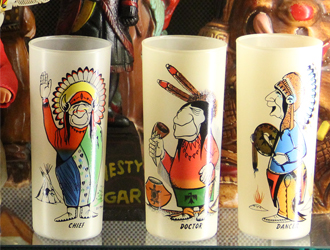 "Stereotypes Sell": Commercialization of Indians
Stereotypes sell. To this solar day, consumers recognize the stylized Indian primary on cans of Calumet blistering pulverisation and the kneeling Indian maiden on packages of State O'Lakes butter. [fifteen]
For hundreds of years, merchants accept used images of American Indians to annunciate and market merchandise. Products include tobacco, associated with Native Americans, advertised via tobacconist figures, or cigar store Indians, and more. Co-ordinate to author Ralph Sessions, "English tobacconists were amongst the first to capitalize upon the paradigm of the Native Americans." [16] Figures, intended to stand for the inhabitants of the New World, advertised shops conveying the "Indian weed." "The earliest visual prove of the utilise of a tobacconist figure in America," Sessions notes, appears exterior a tobacco shop depicted in an 1810 watercolor past painter Baroness Hyde de Neuville. [17]
The tobacconist figures, made from forest or bandage iron, soon became popular beyond Northward America. At commencement, "the female person figure . . . was by far the more popular, outnumbering male figures four to one." [18] Omnipresent as today's neon signs and billboards, these figures normally appear as generically "Indian." Cigar shop Indians and other products associated with tobacco go on to appear across commercial venues.
Marketers also invoked Native associations with herbs and plants to sell medicinal concoctions. Pop during the 1800s, Indian medicine shows, a number featuring Indian or Indian-impersonator performers, pitched a range of patent or proprietary (beyond the counter) nostrums or remedies equally cure-alls, amongst them Kickapoo Indian Salve, Big Chief Liniment, and Indian Stomach Bitters. The burgeoning advert industry was patently instrumental to the rise of medicine shows during the period. As writer Brooks McNamara points out, "Nostrum advertising continued to develop on a biggy scale in nineteenth-century America," with presses pouring along "a sea of handbills, posters, flyers, complimentary magazines, trade cards" and more than to promote products. [19]
Native nutrient associations, too, contributed to companies promoting a range of products using Indian names, titles, and images. "Advertisement objectifies," author Deborah Doxtator notes. "It transforms the image of historical figures such as Tecumseh … and Pontiac into niggling objects that can exist possessed, used up and thrown away." [20] The same is truthful of commercialization that exploits titles (Large Chief Meat Snacks) and "loanwords" (Squaw Peas). Furthermore, when companies appropriate tribal names like Sioux (Sioux Bee Dearest/Sue Bee Honey), they suggest an association with specific Indian nations.
Once advertisers in America, Nihon, and other countries began using images of Native people after the 1850s, historian Daniel Francis writes: "Suddenly images of the Indian were actualization on the pages of mass-circulation magazines, on billboards, on the shelves at the local supermarket." [21] These images relegate people to a timeless by. "Any appropriation of American Indian images or cultural imagery to sell a product," scholar Victoria E. Sanchez asserts, "amounts to perpetuation of institutionalized racism and is a contributing factor to insensitive stereotypes, prejudice, discrimination, and stigmatization." [22]
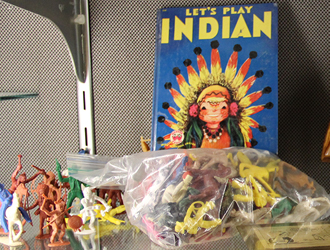 "Self-Shaping": Playing Indian
While minstrel shows have long been criticized as racist, American children are still socialized into playing Indian. Columbus Day celebrations, Halloween costumes and Thanksgiving reenactments stereotype Indigenous Peoples equally i big distorted culture. We are relegated to racist stereotypes and cultural caricatures. [23]
Let's Play Indian, a children's volume by Madye Lee Chastain, is one of countless examples of playing Indian, a practice engaged in past outsiders who appropriate, or take on, American Indian identities and cultural ways. Chastain'due south main graphic symbol transforms herself into "a really truly dressed-upwards painted Indian," who runs, whoops, and waves her tomahawk. [24] Equally columnist Ruth Hopkins notes, "Some folks contend that since it's acceptable to clothes up as a cowboy, they should get a pass for dressing up as an 'Indian.' Wrong." [25] While children frequently dress upwardly to play a cowboy, nurse, or fireman, these are occupations. Existence American Indian is not a profession or vocation. It is a human identity, tribally specific and integral to Native personhood and nationhood.
Let'southward Play Indian is not an isolated example of playing Indian. Actually, the exercise has a long history. As scholar Rayna Green writes: "Near from their very arrival in the Americas, Europeans establish it useful, perhaps essential, to 'play Indian' in America, to demand that tribal peoples 'play Indian,' and to export the performances dorsum to Europe, where they thrive to date." [26] The Boston Tea Party, which helped spark the American Revolution in 1773, is an early example. Sounding war whoops and masquerading equally Mohawks, colonial men boarded ships in Boston Harbor and threw chests of tea overboard to protestation British tea taxes. White males such as these were the showtime of many participants to engage in Indian play. Woodcraft Indians, Camp Fire Girls, Boy Scouts, Wild Westward and Indian medicine shows, hobbyists, and sports teams are among numerous examples. Playing Indian cuts across race, class, gender, age, and group affiliations. Some people appoint in such "play" temporarily, equally in Halloween costuming, merely others appropriate Indian names and identities on an ongoing basis.
Playing Indian likewise extends to depictions of animals dressed equally Indians in a variety of products, including books and toys. These portrayals are dehumanizing, suggesting that Native people are creatures of fantasy and non fully man.
Playing Indian with one-size-fits-all images of American Indians is contrary to actual Native peoples, past or present. Such practices prevent other people from learning about, or agreement, Native America. Such "play" masks depression per-capita incomes, high unemployment, poor wellness, and other realities. As Philip J. Deloria, author of Playing Indian, points out: "…the ways in which white Americans have used Indianness in artistic self-shaping accept continued to be pried apart from questions about inequality, the uneven workings of power, and the social settings in which Indians and non-Indians might actually meet." [27]
 "Braves" and "Chiefs": Indian Mascots
Native American mascots have very little to do with Native Americans. They do not, nay, cannot, correspond indigenous men and women. Much similar blackface, such inventions and imaginings, meant to represent a racial other, tell united states much more nigh Euro-Americans….They reflect and reinforce the central features of racial and gendered privilege in a settler society, particularly a sense of entitlement to take and remake without consent and to do so without the brunt of history, the challenges of knowing, or the risk of penalization. [28]
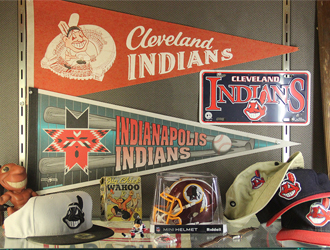
A pop version of playing Indian arose in the early on office of the twentieth century in organized sports, with squad names such every bit Braves, Chiefs, Indians, Savages, Redskins, and Warriors. These monikers, evoking masculine ideals of bravery and aggression, became widespread at a range of institutions, including 1000-12 schools, colleges and universities, and amateur and professional athletic leagues and franchises.
Teams with "Indian" names come with a diverseness of practices, amidst them the adoption of "red-face" mascots costumed every bit Plains Indians, ersatz Indian dances and rituals at halftime, face paint and feathered headdresses, and the antics of war whooping, tomahawk chopping fans. Band members, drill teams and cheerleaders (including "Indian princesses," "Redskinettes," and the like) contribute to the overall theme. Such representations have go normalized, a familiar part of everyday America. "These images are so powerful," activist Charlene Teters has testified, "that many non-native people practise not encounter us as modernistic people with a valued history, living culture, language or a hereafter." [29] Challenging such images requires seeing them for what they are (and are not). Author Dave Zirin, for instance, notes: "I started looking into [the Redskins] more later a young girl of Native American beginnings saw the logo on a media folder in my bag and asked me appallingly why 'the human's caput had been chopped off.'" He concluded: "…once you lot see it, y'all can't unsee it." [thirty]
Squad logos, rife with "chopped off" Indian heads, are emblazoned on fields and arenas, programs and memorabilia, and beyond a range of venues. Audiences, fans or not, are bombarded with radio, telly, newspaper, and electronic media coverage. Teams, especially franchises worth billions of dollars, market an amazing array of commercial products, such every bit pennants, caps, mugs, plates, notebooks, mascot figures, bobble heads, and fifty-fifty toilet paper. Starting with infant dress and other trade, marketing is aimed at all age groups, the meliorate to groom fans and keep revenue flowing into team coffers.
Demeaning "Indian" language, besides, reinforces imagery, every bit in:
Hail to the Redskins.
Hail Victory!
Braves on the warpath.
Fight for old D.C.
Scalp 'um, swamp 'um, nosotros will
Take 'um big score. [31]
Although some teams take denied or sanitized racist versions of fight songs and other representations, the historical record reveals the truth. Through efforts by opponents of Indian mascots, a number of institutions, especially at the M-12 and higher levels, take changed a range of practices, including squad names. Professional teams such as the Redskins and the Cleveland Indians take been the most resistant to change.
 "I is for Indian": Globe of Children
But I am hurt and often outraged past how my children experience their Indianness in mainstream America. [32]
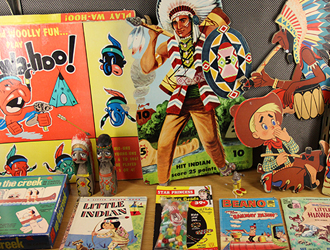
The lives of children are saturated with American Indian stereotypes: "I for Indian" in alphabet books, "Ten Little Indians" vocal and dance, plastic "Indian villages," coffee-tin can "tom-toms," cardboard totem poles, "Indian" Barbie dolls, Pocahontas costumes, and more. As educator Jim Due east. Warne has testified, "Today'south average U.S. didactics about Indians is reduced to cutting out structure paper feathers, coloring book tepees and tomahawks, and Pilgrim hats for Thanksgiving." [33]
Consequent with such instruction, "I for Indian" as well often appears in alphabet blocks, cards, and books. Juxtaposed with objects (A for apple, B for ball), it is likewise accompanied past a dancing, whooping, war painted "Indian" and other stereotypical imagery. Besides objectifying Native peoples, "I for Indian" is known to manifest "the anachronistic placement of past-tensed 'Indians' with mod items or settings."[ 34] Such anachronisms contribute to misconceptions nigh Native Americans, past or present.
Native people are also treated equally objects in counting songs, books, and toys. "Ten Little Indians" is the best known example by far, actualization in nursery schoolhouse curricula, toys, recordings, games, YouTube videos, and theater productions. Written in 1868 as "X Little Injuns" by songwriter Septimus Winner, this hitting "comic song and chorus" features "injuns" dying by dissimilar means "until there were none." [ 35] Adults go along to teach the song, seemingly oblivious to its fierce, racist history, counting downwards Indians to annihilation.
Clinical psychologists written report that constant encounters with false images outcome in Native children internalizing stereotypes that interfere with their developing positive cocky-images and racial identities. Besides, researchers take studied the development of racial sensation, attitudes, and feelings in immature children. "The first six years of life are important for the development of all social attitudes," psychologist Gordon Allport has written. "A bigoted personality may be well under manner by the historic period of six…." [36] For writer Mary Gloyne Payne Byler, "far from being harmless, stereotypes are one of the nigh common manifestations of prejudice and 1 of the nigh persistent." [37]
Whatever the source, inaccurate images and information well-nigh Native people are particularly harmful during children'southward formative years. In a study by Children NOW, a child advocacy organisation examining children's perceptions of race and class in the media, Native youngsters said they see themselves as "poor," "drunkard," "living on reservations," and "an invisible race." [38] The Children NOW report concludes that "Native American youth are concerned near portrayals of their race in the media." [39] So are countless historians and other educators who object to the maltreatment of Native peoples and cultures. Scholar Michael Dorris puts it bluntly: "To deprive our children (who grow up to become no less deprived adults) access to the wealth and sophistication of traditional Native American societies is indefensible . . . this treasure trove of experience and intelligence, perfected over tens of thousands of years residence on this continent, is allowed to be eclipsed past impaired, racist drivel." [40]
References
i C. Richard King, redskins: Insult and Brand (Lincoln: University of Nebraska Printing, 2016), 100.
2 Cécile R. Ganteaume, "Americans: Major New Exhibition Asks, Why Exercise Images of American Indians Permeate American Life?" National Museum of the American Indian magazine, vol. 18, no. 3 (Fall 2017): 20-27.
three Kevin Gover, "Five Myths about American Indians," The Washington Mail service, November 22, 2017. https://www.washingtonpost.com/outlook/five-myths/five-myths-near-american-indians/2017/eleven/21/41081cb6-ce4f-11e7-a1a3-0d1e45a6de3d_story.html?utm_term=.c73ca14f9617 (accessed January xiii, 2018).
four Gover, "Five Myths nigh American Indians."
five Gover, "Five Myths virtually American Indians."
6 National Congress of American Indians, "Tribal Nations and the Usa: An Introduction," January 15, 2015. http://www.ncai.org/about-tribes (accessed January 13, 2018).
7 Elias Johnson, A Native Tuscarora Principal. Legends, Traditions and Laws of the Iroquois, or Six Nations, and History of the Tuscarora Indians. Lockport, NY: Marriage Publishing Co., 1881. [reprints available]
8 André B. Rosay, "Violence Against American Indian and Alaska Native Women and Men," U.S. Department of Justice, Office of Justice Programs National Institute of Justice, May 2016. https://www.ncjrs.gov/pdffiles1/nij/249736.pdf (accessed Jan 15, 2018).
9 Melanie Peterson-Hickey, "American Indians, Mental Health, and the Influence of History," American Psychiatric Association weblog post, November six, 2015. https://www.psychiatry.org/news-room/apa-blogs/apa-weblog/2015/11/american-indians-mental-wellness-and-the-influence-of-history (accessed January xv, 2018).
x Emma LaRocque, "Here Are Our Voices—Who Will Hear?" Preface to Writing the Circle: Native Women of Western Canada, compiled and edited by Jeanne Perreault and Sylvia Vance (Norman: University of Oklahoma Printing, 1993), xv.
xi Elizabeth Seay, Searching for Lost Urban center: On the Trail of America's Native Languages (Guilford, CT: The Lyons Press, 2003), ix.
12 J.D.C. Atkins, "The English Language in Indian Schools," in Americanizing the American Indians: Writings by the "Friends of the Indian" 1880-1900, ed. Francis Paul Prucha (Lincoln: University of Nebraska Press, 1978): 197-206.
xiii Suzan Shown Harjo, "Watch Your Linguistic communication!" Indian Country Today, July iv, 2001. https://indiancountrymedianetwork.com/news/scout-your-language/ (accessed October 26, 2017).
xivMary Gloyne Byler, "Taking Some other Look," in Through Indian Optics: The Native Experience in Books for Children, eds. Beverly Slapin and Doris Seale (Philadelphia, PA: New Society Publishers, 1992): 81-87.
xv Jeffrey Steele, "Reduced to Images: American Indians in Nineteenth Century Advertising," in Dressing in Feathers: The Construction of the Indian in American Pop Culture, ed. S. Elizabeth Bird (Bedrock, CO: Westview Press, 1996): 45-64.
16 Ralph Sessions, The Shipcarvers' Art: Figureheads and Cigar-Store Indians in Nineteenth-Century America (Princeton and Oxford: Princeton Academy Press, 2005), 86.
17 Sessions, The Shipcarvers' Art, 86.
18 "Cigar-Store Indian," in Encyclopedia of Northward American Indians, ed. Frederick Hoxie (Boston: Houghton Mifflin, 1986), 123.
19Brooks McNamara, Step Correct Upwards: An Illustrated History of the American Medicine Bear witness (Garden Urban center, NY: Doubleday & Co., 1976), 13, 16.
20Deborah Doxtator, Fluffs and Feathers: An Exhibit on the Symbols of Indianness: A Resource Guide (Brantford, Ontario: Woodland Cultural Centre, revised edition, 1992), 46.
21Daniel Francis, The Imaginary Indian: The Image of the Indian in Canadian Culture (Vancouver, B.C.: Armory Pulp Press, 1993), 175.
22Victoria Due east. Sanchez, "Buying into Racism: American Indian Production Icons in the American Marketplace," in American Indians and the Mass Media, eds. Meta Chiliad. Carstarphen and John P. Sanchez (Norman: University of Oklahoma Printing, 2012): 153-168.
23Dwanna 50. Robertson, "Playing 'Indian' and Colour-Blind Racism," Indian Country Today, September 20, 2013. https://indiancountrymedianetwork.com/news/opinions/playing-indian-and-color-blind-racism/ (accessed October thirty, 2017).
24Madye Lee Chastain, Permit's Play Indian (New York: Wonder Books, 1950).
25Ruth Hopkins, "My Native Identity Isn't Your Plaything. Stop with the Mascots and 'Pocahotties,'" The Guardian, June nineteen, 2015. https://www.theguardian.com/commentisfree/2015/jun/xix/my-native-identity-isnt-your-plaything-mascots-pocahotties (accessed Oct 2, 2017).
26Rayna Green, "The Tribe Called Wannabee: Playing Indian in America and Europe." Folklore, vol. 99, no. 1 (1988): 30-55.
27Philip J. Deloria, Playing Indian (New Haven, CT: Yale Academy Press, 1998), 189-190.
28C. Richard Rex, redskins: Insult and Brand, 31-32.
29Charlene Teters, in "Stolen Identities: The Impact of Racist Stereotypes on Indigenous People," Hearing before the Committee on Indian Diplomacy, United States Senate, 112th Congress, May v, 2011. https://www.gpo.gov/fdsys/pkg/CHRG-112shrg66994/pdf/CHRG-112shrg66994.pdf ( accessed October 29, 2017).
30Dave Zirin, "You Tin't Unsee It: Washington Football Proper name and Quiet Acts of Resistance," The Nation, September 5, 2014. https://www.thenation.com/article/you-cant-unsee-it-redskins-and-placidity-acts-resistance/ (accessed October vi, 2017).
31Connie Griffith, My Life with the Redskins (New York: A.Due south. Barnes & Co., 1947), 39.
32Nancy Marie Mithlo, "Our Indian Princess": Subverting the Stereotype (Santa Fe, NM: School for Advanced Research, 2009), viii.
33Jim E. Warne, in "Stolen Identities: The Touch on of Racist Stereotypes on Indigenous People." https://world wide web.gpo.gov/fdsys/pkg/CHRG-112shrg66994/pdf/CHRG-112shrg66994.pdf (accessed October 29, 2017).
34Robert B. Moore and Arlene Hirschfelder, "Feathers, Tomahawks and Tipis: A Written report of Stereotyped 'Indian' Imagery in Children'due south Film Books," in American Indian Stereotypes in the Globe of Children: A Reader and Bibliography, iind ed., eds. Arlene Hirschfelder, Paulette Fairbanks Molin, and Yvonne Wakim (Lanham, MD: The Scarecrow Press, 1999): 55-eighty.
35Julianne Jennings, "The History of 'Ten Little Indians,'" Indian Country Today, October xi, 2012. https://indiancountrymedianetwork.com/civilisation/social-issues/the-history-of-x-little-indians/ (accessed January 15, 2018).
36Gordon Allport, The Nature of Prejudice (Reading, MA: Addison-Wesley Publishing Co., 1954), 297. [Reprint edition: New York: Basic Books, 1979]
37Mary Gloyne Payne, "Editorial: Mary Gloyne Payne," Indian Affairs, no. 62 (December 1965), 5.
38Children At present. A Different World: Native American Children's Perceptions of Race and Class in the Media. (Oakland, CA: Children NOW, 1999), https://files.eric.ed.gov/fulltext/ED436234.pdf (accessed January 15, 2018).
39Children NOW.
40Michael A. Dorris, "Foreword to the First Edition," in American Indian Stereotypes in the Globe of Children: A Reader and Bibliography, 2nd ed., seven-viii.
martinezlifew1959.blogspot.com
Source: https://www.ferris.edu/HTMLS/news/jimcrow/native/homepage.htm
0 Response to "What You Know About Indians Native American Issues Are Not History"
Post a Comment